
TRC-P Symbols
Section outline
-
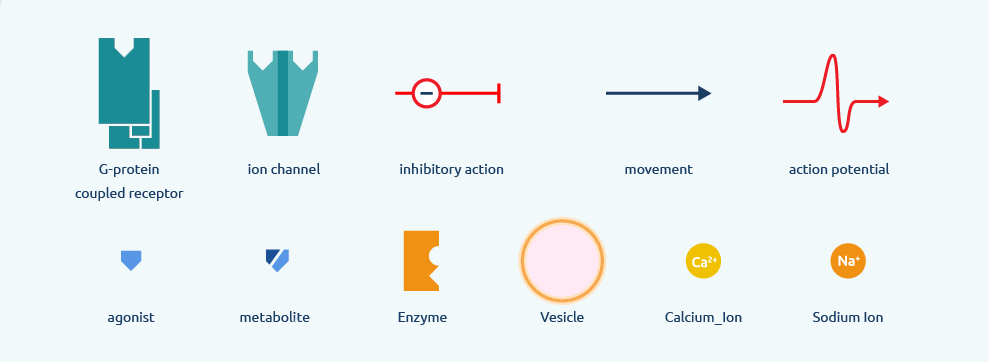
The symbol database plays a vital role in the TRC-p, as it facilitates the creation of illustrations tailored specifically for students. TRC-P distinguishes by other pharmacological learning platforms by using illustrations build from consistant symbol use, rather than learning from text(book). This does not mean that TRC-P does not use text for (additional) explanation (it does!), but the primary understanding of drug mechanisms should be developed via the illustration, by understanding the symbol-language. It usually takes a few hours (2-3) to understand most of the symbol and 'language use'. Once understood, comples compositions with many symbols are understood quickly. Students (and teachers) therefore not only use the TRC-P as a tool to understand new drug mechanisms, but it is also often used as a 'reference library', to quickly look up drug mechanisms that have been learned in the past (and 'forgotten'). And of course, teachers use the TRC-P as a free-to-use resource for illustrations, as all illustrations can be freely used for educational purposes (see "Using & Sharing TRC-P illustrations / Copyright")
-
By exploring the link above, students will better understand how the symbols contribute to the explanation of the illustration 'neuronal synapse'. As a metaphor: the symbols can be seen as individual letters, and when combined, can form words and sentences and create a whole language (all the illustrations on the TRC-P).
Note that students can hover over the illustration for more information on specific symbols, or click on them for more information.
-
A short Quiz is provided to test some of the basic knowledge of the TRC-P's symbol/language use.
-